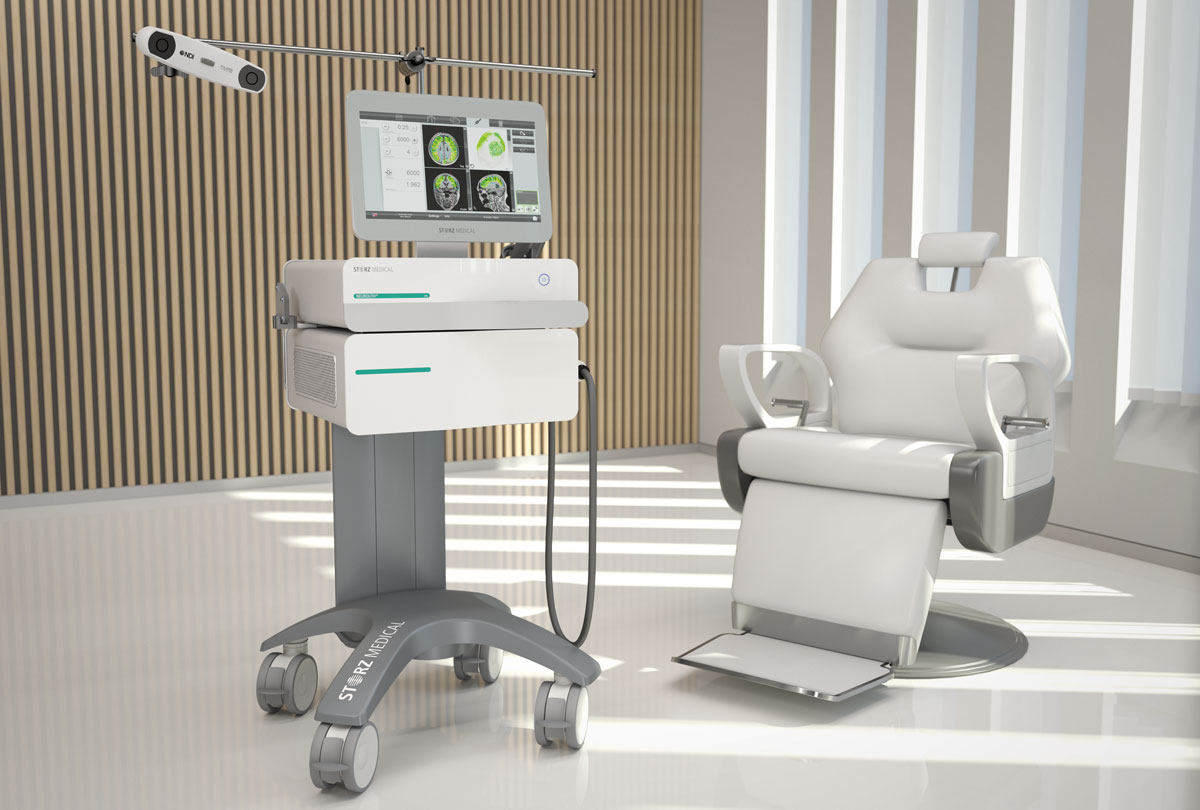
The Neurolith® by Storz Medical delivers ultra-short, low-energy acoustic pulses to stimulate neurons non-invasively, without pain and with no serious adverse event reported.
These data come from the published studies and from the clinical experience of the Düsseldorf reference centre (5 years of activity). This device is not a substitute for specialist medical follow-up.
TPS (Transcranial Pulse Stimulation) is a non-invasive neuromodulation technique using mechanical waves — ultra-short acoustic pulses (3 µs) at low energy (0.1–0.25 mJ/mm²) — to selectively stimulate target brain structures (art. R4321-7 of the French Public Health Code).
Guided by the patient's MRI, the Neurolith® by Storz Medical delivers these pulses with millimetric precision, reaching areas inaccessible to other ultrasound stimulation techniques.
Unlike rTMS or tDCS, this ultrasound neuromodulation technique allows three-dimensional stimulation at depth, including the hippocampus, the medial prefrontal cortex and the basal ganglia — structures directly involved in Alzheimer's disease, Parkinson's disease and treatment-resistant depression.
A session lasts about 45 minutes; the patient is seated and feels no pain. No anaesthesia and no drug preparation are required.
Acoustic shockwaves exert mechanical forces on cell membranes, activating intracellular signalling pathways and stimulating the production of growth factors.
Stimulation of VEGF production, promoting the formation of new vessels and improved local cerebral perfusion in the targeted areas.
Production of endogenous NO inducing local vasodilation and an anti-inflammatory action, improving the oxygenation of the target brain tissues.
Release of neurotrophic factors promoting neuronal survival, neurite growth and the repair of damaged synaptic circuits.
Stimulation of the production of new neurons in the hippocampus and promotion of their integration into existing circuits — a region critical for memory.
Induction of long-term potentiation mechanisms, strengthening synaptic connections and improving the efficiency of the neural networks involved in cognitive functions.
The centre offers neuromodulation programmes using Transcranial Pulse Stimulation (TPS) after clinical assessment and verification that there is no contraindication. A favourable opinion from the neurologist or treating physician is systematically required before any protocol.
Helping to preserve memory, language and day-to-day independence. Rehabilitation of impaired cognitive functions (memory, attention, executive functions) through targeted ultrasound stimulation. Assessment with MoCA, STROOP, BDI-II.
Aiming for greater ease in everyday movements — walking, writing, mobility. Functional rehabilitation of motor disorders (tremor, rigidity, bradykinesia) through ultrasound stimulation. Assessment with MDS-UPDRS III and BDI-II.
Supporting the return of drive, attention and emotional balance. Functional rehabilitation of attentional and emotional-regulation capacities, alongside psychiatric follow-up.
Acting early, when there is most capacity left to preserve. Early functional rehabilitation of executive and memory functions. Preservation of residual functional capacities.
Helping to improve concentration and attentional stability. Rehabilitation of sustained attention and working memory through ultrasound stimulation. Neuropsychological assessment before and after. (Exploratory indication — preliminary data.)
Supporting cognitive abilities and behaviour in daily life. Rehabilitation of impaired cognitive and behavioural functions. Functional support complementing neurological follow-up. (Exploratory indication — preliminary data, by extension from the Alzheimer's findings.)
Aiming for a steadier, more precise movement. Functional rehabilitation of motor control. Assessment with the ETRS scale before and after the rehabilitation programme.
Functional recovery after ischaemic stroke (> 6 months), neurological post-COVID syndrome, MSA, central neuropathic pain. (Exploratory indications — preliminary data only.)
Not covered by the French national health insurance (Assurance Maladie) · payment in instalments possible
Some functional impairments — in particular severe mood disorders and advanced forms of cognitive or motor impairment — may require 10 to 12 sessions according to the data in the literature. A personalised quote is systematically provided at the first consultation, so that the rehabilitation programme can be adapted to the available scientific evidence and to each patient's clinical situation.
The only TPS medical device with MRI guidance (BodyTrack®) for precision brain targeting down to 8 cm in depth.
Official presentation video of the device by Storz Medical.
© Storz Medical AG
The clinical trials published in leading journals (including JAMA Network Open) confirm the efficacy of ultrasound stimulation for the rehabilitation of cognitive functions, with improvements documented in the short and medium term using standardised instruments (CERAD CTS, ADAS-Cog, MoCA).
| Study | Main finding |
|---|---|
| Beisteiner et al., Advanced Science 2019 Pilot study |
Significant improvements, stable at 3 months (CERAD, MoCA, MMSE) |
| Matt et al., JAMA Network Open 2025 Double-blind RCT — 60 patients |
+3.91 pts CERAD CTS at 3 months (≤70-year subgroup, vs −1.83 sham) |
| Cont et al., Düsseldorf Real-world cohort |
+15.76% total ADAS score +8.65% ADAS cognitive |
Specific rehabilitation programmes have shown a significant reduction in motor impairment as measured by the UPDRS-III. The centre follows a rigorous scientific approach: a standardised assessment at entry and at discharge, contributing to the international database.
| Study | Main finding |
|---|---|
| Cont et al., Frontiers in Neurology 2024 20 patients, 10 sessions |
UPDRS-III: 16.70 → 12.95 (p < 0.001, Cohen's d = 1.38) −22% motor symptoms |
| Gianlorenco et al., Journal of Neurology 2026 Harvard Medical School — Spaulding / Mass General Brigham (Prof. Fregni), 14 patients |
Total UPDRS −21.4% (maintained at 1 month) Cognition +25%, depression −40%, improved quality of life |
| All published studies | 0 serious adverse event reported |
positive clinical response (improvement or stabilisation) — unpublished observational data from the Düsseldorf reference centre, 5 years of activity
A physiotherapist and osteopath for 18 years, based at 7 rue Anatole de la Forge, Paris 17th, I devote a growing part of my practice to the neuromodulation of cognitive and motor impairments of neurological origin.
Trained in the TPS technique in Düsseldorf with Prof. Sprick, Dr Günes and the Storz Medical teams, pioneers of this approach in Germany, I chose to create the first TPS neuromodulation centre in France in order to offer my patients with Alzheimer's disease, Parkinson's disease or treatment-resistant depression a serious option, based on the published data, with no serious adverse event reported in the studies.
This project grew out of a conviction: patients with cognitive or motor impairments of neurological origin deserve access to the most advanced rehabilitation techniques as soon as those techniques show a satisfactory safety profile and measurable results.
The rehabilitation programme offered is structured, reproducible and documented. Every patient receives a standardised assessment before and after rehabilitation. A full report is sent to the referring physician at the end of the programme.
I work in close collaboration with the neurologists and psychiatrists who follow my patients, and I undertake not to treat any patient whose profile is not compatible with TPS.
Download our information letter for physicians and our referral form